
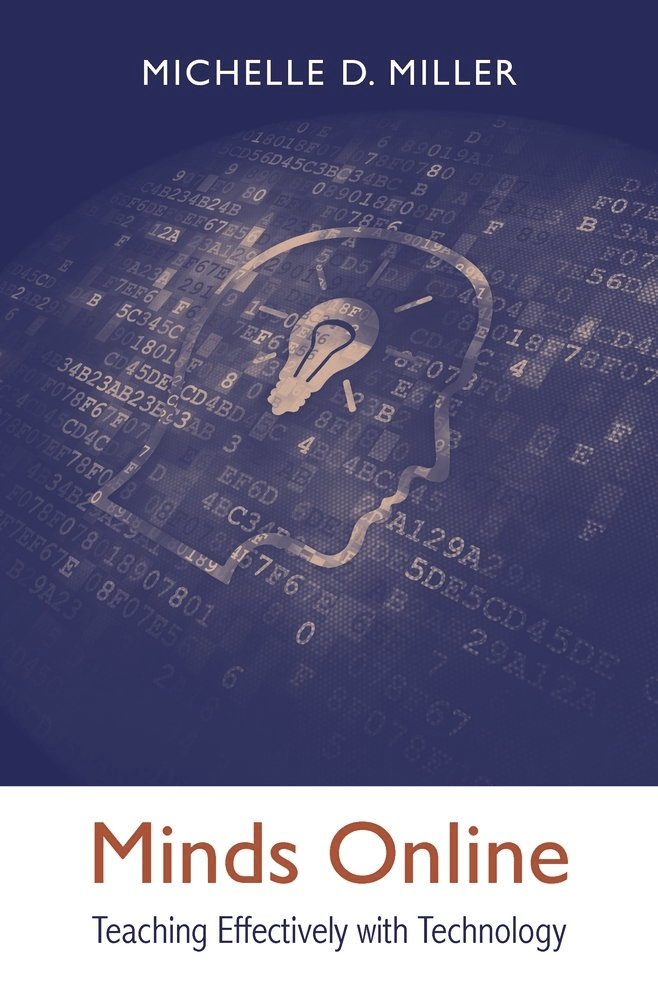
Book Review – Minds online: Teaching effectively with technology
Author: Michelle D. Miller (2014). Cambridge, Massachusetts, 279 pp., ISBN: 978-0-674-36824-8
Reviewer: Kim S. Johnson, John Brown University, Siloam Springs, Arkansas, USA
Designing engaging and effective learning experiences and learning environments is a goal for educators and instructional designers. Due to recent advancements in educational technology and in cognitive psychology, students – and in this case online students – can be provided with learning experiences supported by knowledge of how the brain functions, thus promoting better learning. First, a case is made for online learning and its promise for effective learning. Then the focus shifts to cognition, particularly attention, memory, and thinking. A deep dive into each of these topics yields specific strategies for online teaching and learning. Multimedia theory and principles are examined and are followed by strategies for keeping students motivated. The final chapter pulls all of these elements together with examples for designing a course based on research.
As an instructional designer, online instructor, and online student, I’ve found this book to be a valuable resource. My purpose here is to provide a review to share this book with others involved in distance learning. Provided here is an overview of the book’s content, my reaction, and recommendation.
Dr. Miller is Professor of Psychological Sciences and President’s Distinguished Teaching Fellow and at Northern Arizona University. She is also serves as Director of First Year Learning Initiative. It is a program focused on the redesign of lower level core courses to improve engagement, effectiveness, and retention. Dr. Miller’s background is in cognitive psychology, with research interests including memory, attention, and most currently, course design for effective learning experiences based on brain science.
The purpose of the book is to examine the use of educational technology along with cognitive psychology, providing practical applications for successful online teaching with technology in higher education. Though the focus is on online learning, most of the best practices are applicable to face-to-face learning as well. The author puts forth the argument that advancements in educational technology and cognitive psychology can be utilized in designing instruction that maximizes student success.
The book consists of nine chapters which include:
- Is Online Learning Here to Stay?
- Online Learning: Does It Work?
- The Psychology of Computing
- Attention
- Memory
- Thinking
- Incorporating Multimedia Effectively
- Motivating Students
- Putting It All Together
The book organized into three basic sections. The first section addresses foundations of online learning in higher education and addresses some common questions regarding topics such as comparing the effectiveness of online and face-to-face teaching and learning, cheating, and effects of technology use. The second section focuses on topics regarding cognition. The author provides examples and resources for psychological tests or demonstrations that support her claims in chapters on cognition. The final section includes practical applications for teaching with technology that is supported by brain science. Resources such as websites or databases are shared for most types of activities described.
Information presented was published in 2014 and was written with the purpose of providing relevant information using current technology and research in designing effective learning. Major strengths of the book include its organization, clarity, and readability. Other strengths include the research, number of examples, and resources provided throughout the book.
As far as weaknesses, none are noted. A digital resource would be a nice addition to the book. Perhaps including some printable resources such as the Reading Matrix, Multimedia Principles within the digital resource would be helpful. The book is a significant contribution to theory, research, and best practices in distance learning.
A valuable resource to educators and instructional designers, it is one that I would highly recommend. It will be a treasured resource that I revisit often since it is packed with reliable information that supports online and blended learning. Included are research-based strategies, examples, ideas, and resources. Myths are debunked. Online learning strategies tied to attention, memory, and thinking are provided, and detailed sections on accessibility and gamification are included.
In addition, a multitude of resources such as databases and websites for activities such as project-based learning ideas, case studies, and tools. The sections on motivation and incorporating multimedia provided numerous tips. In the final chapter, the author provides questions, principles, tools and techniques for each element of course design to guide in planning a course. Also included is a fully-developed syllabus including foundational cognitive support for the design. So much is packed into this useful book!
 Catalyst