
Blog

PD, PLN

Real Time and Live Virtual Professional Development

Over the past couple of weeks I’ve participated in four live Twitter chats and four live webinars as real time and live virtual professional development. It was a great experience. The webinars were made even better by participating with several other students from EdTech 543, and just about every time I’ve logged in to Tweetdeck, I’ve seen students from 543 in chats, and that’s been really fun.
Before this class, I had participated in two or three chats. Now that I’m using Tweetdeck, it has made the chat experience much more fun and easy to manage. Most of the chats are fast moving, so you have to be on your toes. I was able to keep up and answer each question and enjoy the responses of others in the chat. I gained some new followers, some likes, and retweets in the process. I can see that the time spent interacting is definitely helping me make connections. I’ve been logging in to Tweetdeck every day since and have noticed that I’m spending more time there now, than I am on Facebook. With the live chat, I like that there is usually a topic with pre-planned questions. Everyone seems cheerful, positive, encouraging, and wanting to learn new things.

Since 2013, I’ve attended a number of live webinars because of my work in virtual environments. The first webinar I signed up for for this assignment didn’t have a back channel conversation. You couldn’t see if there were other participants or not, and there was a place specifically labeled for questions, but it didn’t look welcoming for comments. So next, I attended four straight sessions on Google Apps hosted by SimpleK12. What made these a little different, is the chat in the webinar was only for asking the presenter a question, and you couldn’t see the questions others were asking. The rest of the chat was on another site. In a way, I found that a little bit distracting, probably since I was trying to contribute to the chat often though. I really like that they keep the transcript of the chats posted. Even though I’ve used Google apps for awhile and I’m Google Certified, I found these sessions very valuable.

Here is the list of chats and webinars I participated in and a brief summary. In each chat, I answered all the questions, liked tweets, and found some new people to follow. In the webinars, I tried to keep a fairly steady stream of comments or questions going. Click on them to link to the transcripts.

6/15/17 #EduAr Twitter chat
This chat for Arkansas educators was all about books.We shared books that are inspiring and have contributed to shifts in our thinking. We shared quotes or other things to inspire others to read the books and shared how we decide what to read next. Also discussed was how to share new learning from the books we read. Lists of must-read professional books were shared. I have several books on my list to read that I’ve found on Twitter.
6/21/17 #Educoach Twitter chat
As a former instructional coach, I have lurked on this chat several times in the past. This time we discussed what culture looks and sounds like where coaching is important, what barriers are there to schools valuing coaching, what supports help build a culture that find coaching valuable, what coaches can do to help build rapport to build a coaching culture, what leadership can do to build a coaching culture, and how coaches and principals build trust. I’ve had a lot of coaching training and the strategies coaches use in building relationships is also what I’ve been doing as an instructional designer to build relationships, so it was a beneficial chat. I will participate in this one again.
6/22/17 #EduAr Twitter chat
Since I enjoyed connecting with the Arkansas educators, I participated in this chat again. Blogging was the topic – something I’ve been thinking about quite a bit, so I was excited about it. We talked about how blogging supports professional learning, what inspires you to read a blog, how blogging can empower you to voice your thoughts, reasons why people may not blog, tips for blogging, and shared blogs that we like. There was a lot of encouragement and useful ideas in this chat. I will be returning to the transcript to get inspired.
6/24/15 Google Tools: An Introduction for Educators
Since there were to be six sessions on this day, I was hesitant to start with the introduction since I’ve used Google Tools for some time. However, I was pleasantly surprised to find some new ideas. Bunny Pad was new to me for back channel chat. I also learned about new presenter settings in Slides, and that Google Classroom is now available for all, not just schools that use GAFE. For students using mobile devices to collaborate on a doc, they have to have the specific doc app – something I thought was the case, but I asked the presenter to find out for certain.
6/24/17 Go Google for Presentations
I learned that you can embed videos from YouTube or from Google Drive in Slides. I also learned that slides can run automatically embedded in a webpage. The insert picture with the copyright information right there is a great feature that I learned about. You can do Q & A, and there is a laser pointer now available. A good source for templates was shared. http://www.slidescarnival.com/ The presenter shared her presentation as a resource.
6/24/17 Make Google Forms Work for You
Forms are my favorite, and I wasn’t sure how much I would learn from this session. But, I learned that they are now adaptive, and that there is an extension for eliminating answer choices for when you’re using the form as a sign up sheet. Once a choice is selected it goes away. There is a multiple choice grid that’s available.
6/24/17 Amazing Digital Projects for All Students with Google Tools
This presentation was packed with ideas and great visuals. The presenter shared his slide deck in exchange for completing a survey at the end. The presentation focused on locate, capture, create, and remake – a version of SAMR using images. Ideas were shared for using Google Photo, Drawings, Screencastify, Blogging, publishing video in Google Drive, uses for Google Maps, and Photosphere. I’ll be revisiting his presentation in the future.
6/26/17 #EdtechAfterDark Twitter chat
This chat was very quick moving during ISTE week from San Antonio. Lots of GIFs. Rather than a specific topic, there were questions related to a theme of quotes from past speakers from ISTE. We introduced ourselves and named our favorite villain – Catwoman for me. We talked about whether happy accidents are the best way innovation comes about, ideas about how professional development should be, learning from failure, benefits of our PLNs, and engaging students.

Moving forward, I plan to continue participating in chats and webinars. I loved the freedom and flexibility to choose when and where I want to participate. I appreciate the jumpstart this class has provided in helping me move from more of a lurker to a full participant.
PLE

My PLE Diagram Reflection and Comparison

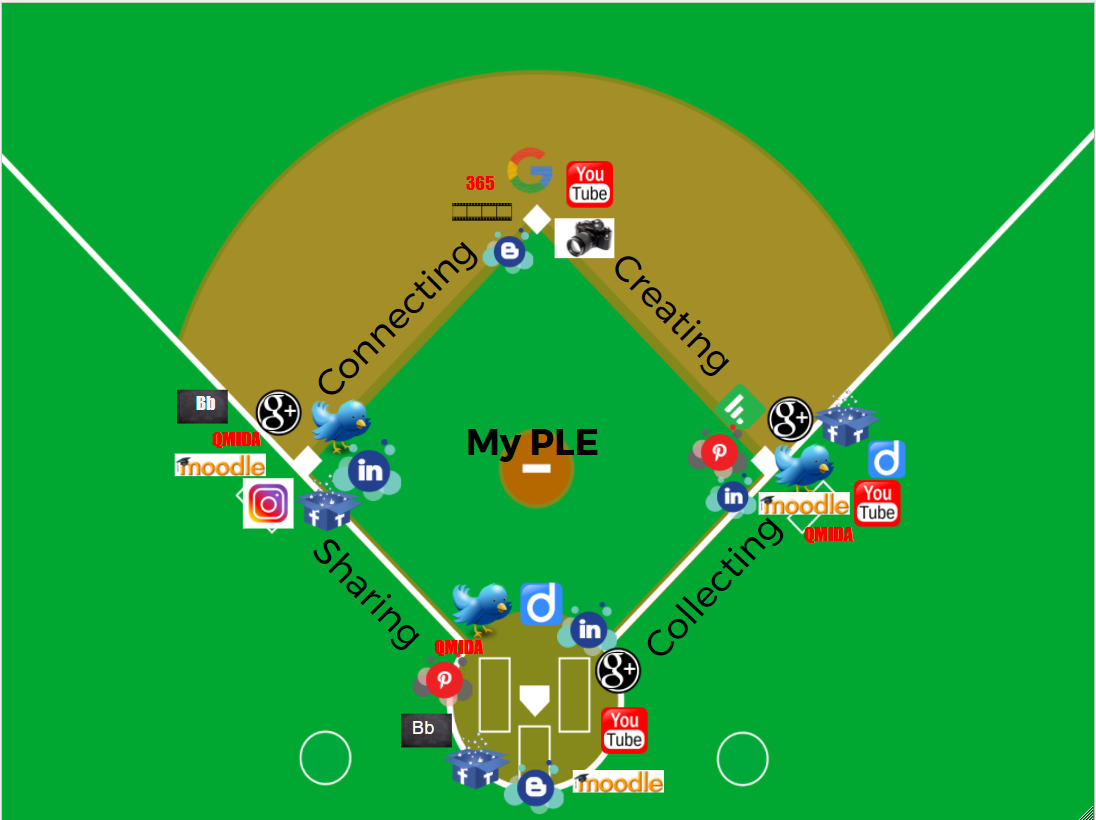
After logging in to some new online communities (two from Google +, one from Linked In, and one from Quality Matters) to my Personal Learning Environment (PLE), I created this diagram using Google Drawings. This was my first time using Google Drawings. It was very simple to use, and it was very easy to find and insert public domain images using this tool. I will be back for more!

After reading about the different models, I was torn between the 4 C’s model and the model with gathering, processing, and acting on learning. Really, they are very similar. I decided to use the four C’s, but I changed the wording a bit and went with the categories of collecting, creating, connecting, and sharing, and then I finally decided on a baseball theme as a metaphor for learning is fun, The design shows connections between the communities at the bases, as well as, along the base paths, and it illustrates the cyclical process of learning as you round the bases.

In looking at my PLE, the areas are pretty balanced and a number of the communities are used in multiple ways which is why it’s a little crowded around those bases. The creating section is more tools for creating things for myself and to share. What I learned in looking at the PLE is that I have a large learning environment. That makes sense since learner is my top strength according to the StrengthsQuest assessment that I’ve taken in the past. When I think about it, it seems as if I spend a little more time collecting than I do creating, connecting, and sharing. However, in my work as an instructional designer, I do more one on one connecting, creating items for courses, and sharing through the courses I’ve worked on and with instructors in the process of developing a course. In my time outside of work, I definitely do more collecting than the other areas, but it’s my goal to change that and bring more balance to my playing field.

Comparisons
In looking at each PLE diagram listed below, at first I was surprised how similar they are. After thinking about it more though, this is how we teach. Each of us chose basically the same categories, however there were some slight twists in wording. We had most communities in common and then a few outlying ones. Even when we had communities in common, they were categorized a bit differently in some cases which could be partly due to using them in different ways. It appears that I have a hard time making decisions – since many of communities are in multiple categories.

Digital Footprint, social presence

Ten Strategies for Creating and Maintaining a Positive Online Presence and Reputation

Image of baby footprints


1. Participate
Participate! Frequent participation yields higher visibility. (Posner, Varner, & Croxall, 2011).
  • Comment on all social media platforms.
  • Post more frequently to Facebook.
  • Tweet and retweet.
  • Participate in chats.
  • Blog.

2. Consistency

Be true! Project the same “voice, image, and persona” no matter the social media platform. (Posner, Varner, & Croxall, 2011).
  • Review all social media profiles, images, and messages for consistency.
  • Be professionally mindful and intentional when posting and sharing.
  • Comment carefully and thoughtfully.
  • Keep the big picture in mind.

3. Update

Profiles, images, and webpages should be up-to-date. Regular updates may increase visibility in search engines. (Lowenthal & Dunlap, 2012).
  • Review and update all social media profiles and images.
  • Update my professional website and webpages.
  • Update RSS feeds with blogs to follow.

4. Organize

Curate teaching and research resources using social bookmarking. (Lowenthal & Dunlap, 2012)
  • Set up Google Alerts for topics of interest.
  • Bookmark resources with Diigo.
  • Tag bookmarks and blog posts.
  • Organize and tag notes.

5. Create

“Create some new assets.” (McGinnis, 2012)
 
  • Create works to publish.
  • Create my own blog.
  • Make my videos public.
  • Share images.

6. Aggregate

Create a digital business card that aggregates online content. (Jones, 2010)
  • Create an About.me.
  • Use as email signature.
  • Add to websites and profiles.

7. Privacy

Create a balance between privacy and public web presence. (Zellner, 2013)
  • Update privacy settings in social media platforms.
  • Check up on these settings regularly.
  • Remember that whatever you post is public and permanent.
  • Post thoughtfully and intentionally.

8. Blog

Create and work on my blog. (Taub, 2012)
  • Share tips, experience, and perspective.
  • Set a goal for post frequency.
  • Share consistently.
  • Consider a theme.

9. Posture

Keep it positive! “Things you say on the net can make you friends or enemies, famous or notorious, included or ostracized.” (Agre, 2002).
  • Avoid negativity.
  • Encourage.
  • Motivate.
  • Enlighten.
  • Edify.
  • Promote.
  • Inspire.

10. Strengthen Network Connections

Continue to strengthen network relationships by meeting face-to-face at professional meetings and conferences. (Agre, 2002)
  • Attend professional meetings and conferences.
  • Arrange to meet contacts in person.
  • Give presentations.
  • Participate in discussions.

References

Agre, P. (2002, March) Networking on the Network: A Guide to Professional Skills for PhD Students.. Retrieved from http://vlsicad.ucsd.edu/Research/Advice/network.html
Jones, J. (2010, November 17 ) Your Digital Calling Card: About.me. [Web log post] Prof Hacker: Teaching, tech, and productivity.  Retrieved from http://www.chronicle.com/blogs/profhacker/your-digital-calling-card-about-me/28755
Lowenthal, P. & Dunlap, J.  (2012, June 5) Intentional Web Presence: 10 SEO Strategies Every Academic Needs to Know. Educausereview. Retrieved from http://er.educause.edu/articles/2012/6/intentional-web-presence-10-seo-strategies-every-academic-needs-to-know
McGininis, S. (2012, August) Online Reputation Management: A How-to Guide. [Web log post] SpinSucks: Professional Develpment for PR and Marketing Pros.. Retrieved from http://er.educause.edu/articles/2012/6/intentional-web-presence-10-seo-strategies-every-academic-needs-to-know
Posner, M., Varner, S., & Croxall, B. (2011, February 14 ) Creating Your Web Presence: A Primer for Academics. [Web log post] Prof Hacker: Teaching, tech, and productivity.  Retrieved from http://www.chronicle.com/blogs/profhacker/creating-your-web-presence-a-primer-for-academics/30458
Taub, A. (2012, June 7) 5 Key Things Needed to Improve your Digital Identity. [Web log post] Entrepreneurs. Retrieved from https://www.forbes.com/sites/alextaub/2012/06/07/5-key-things-needed-to-improve-your-digital-identity/#1952024e932b
Zellner, A. (2013, June 11) Balancing Privacy and Public Web Presence. [Web log post] GradHacker. Retrieved from https://www.insidehighered.com/blogs/gradhacker/balancing-privacy-and-public-web-presence
Photo Attribution – CC0 Public Domain https://pixabay.com/en/baby-footprint-feet-1276064/


Digital Footprint, Social Media, social presence

My Digital Footprint

We are living in the world of George Orwell’s book, 1984. I read it a number of years ago, but each year I see more and more in our world that correlates with that book. Yikes! When first I read it, I remember thinking how odd it was that there were cameras and microphones everywhere, but that is the world we live in today. So interesting that it was written so long ago. I keep thinking that I want to reread it and just need to take the time to do it.

I’m not crazy about the idea of living in the world of 1984, but there are so many good things that it doesn’t seem too bad. However, sometimes I wish things could be simpler again. My kids are just old enough to remember simpler times, but my grandkids will not experience that. I sometimes wish they could.

I’m one of those people who probably care too much about what others think about me, so I’ve been very cautious about my digital footprint from the beginning. Even so, whenever I’ve applied for a job or volunteer position, I’ve done pretty thorough reviews of my public self in preparation as part of the process of filling out applications and updating resumes. So this is not the first time I’ve Googled myself or taken a high level view of my Facebook profile or Twitter account.

My name is a common one, so most of the time you have to add some other information, such as middle name or maiden name, or city and state to actually find me. Not too long ago, I did this and was surprised to find my voter records right away. There my full name, age, address, family members, party affiliation, voting status, and even street view of my house were posted for all to see. They did have my phone number wrong though.

Through another browser and a similar type of site, I found my high school, year I was born, and every address that I’ve lived at since 1983. They had an incorrect email address and employment listed though. I was happy to see that my reputation score according to this site was “good” with a 4 out of 5. Not sure where they got that.

Not surprising, my Facebook and Twitter accounts were prominent. In Google images, I only found two. One was linked to my EdTech 502 website and one was linked to my MET portfolio, so both professional and attached to good information about myself.

All in all, it was a positive footprint that I found, however there was more information about me out there than I would like to see. Even when you try to protect yourself somewhat, it’s not entirely up to you. It’s easy to see how identity theft is so common.

Photo attribution:

“Footprint” by Fil.Al is licensed under CC BY 2.0

PD, PLN, Social Media, Twitter

Twitter Hashtags & Tweetdeck

app-apple-application-58639While attending Arkansas Leadership Academy in 2010, I registered for my Twitter account and began following leaders in education. Now I follow approximately 1300 mostly educators, and I have participated in a few chats. However, I hadn’t ever tried using Tweetdeck. Usually, I would just check Twitter now and then on my phone and came up with many useful things that way. I didn’t do much sharing, but I hope to change that. Now, using Tweetdeck makes it much easier to manage, especially during a quickly moving chat.

So, I started following six hashtags on Tweetdeck including #edchat, #edtechchat, #highered, #EduAr, #edtechafterdark, and #ISTE17. #edchat is really all things education. #edtechchat and #edtechafterdark have more of technology focus. #EduAr is where I can connect with other educators in Arkansas. #highered is focused on teaching and learning in higher education. #ISTE17 will provide a continuous conversation of all that’s going on in San Antonio during this year’s conference. That’s a good mix for me.
It didn’t take long to find several valuable ideas and resources. EdTech for Higher Education posted a list of 50 must-read higher ed blogs on #highered. Nice to have a resource like that that kind of weeds out some blogs and lists some of the better ones. Also on #highered, I found a blog called Teaching Academia that looks interesting. In this post, the author is reflecting on developing content for her online course. Lately, I’ve been considering trying my hand at some academic writing, and I found a post on #highered with a video explaining the different levels of acceptance from editors. That was new information for me.
An educator that I’ve followed for some time posted a paper.li which I’ve never looked at before. It looks like an interesting tool that I may try out for curating and sharing current news in education and educational technology.
In addition, I picked up a couple resources from Free Tech 4 Teachers. One was a list of three resources for images and videos in the public domain. They happen to be ones I’ve used in the past, but a couple of them had fallen off my radar.  Another was a citation tool called Cite It In – something new to try out.
When I first signed up for my Twitter account, I would never have dreamed how beneficial it would be for me professionally. I’ve been picking up resources and ideas on Twitter for years. Now as I plan to step up my game on the sharing and interacting side of it, I can only imagine that it will be even more valuable to me. For just-in-time PD, I really can’t think of anything better. This quote from Dave Mulder rings true for me.

//platform.twitter.com/widgets.js