Blog

Flexible Learning Spaces, Reflection

Reflection 7/29/18

Image by Mark from Pixabay

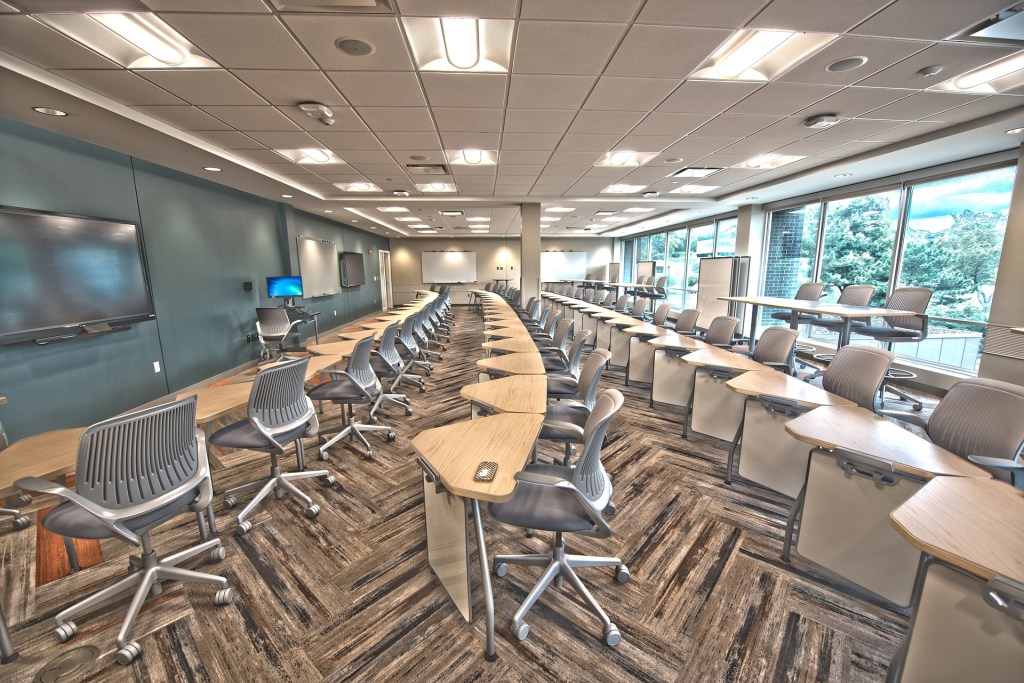
I attended a Learning Spaces webinar that provided a tour of Penn State’s Learning Spaces. It was so interesting and something our office has been discussing. I began researching Flexible Learning Spaces, since it is a project our office is planning on proposing later this month. I think we may even have 4 – 55’’ monitors available as a donation to the project.

I found quite a few resources – videos, websites, articles, and books – that I’ve compiled and shared with our office. I feel like I was a little in the weeds with the project, because I saw where the resources could include those that are reputable, but not peer-reviewed articles. Those happened to be my favorites for this project. It would have been better to have had several stronger resources in addition to the ones I used.

Traveling to Blackboard World while working on the project was challenging too. I brought my Mac Air on the trip, so that is what I used for making my video and training outline. It was challenging to just use one little screen when I’m used to working with two or three larger ones. Next time I would include more scholarly resources, which would make the overall project easier, and hopefully not be traveling. This project very well may have an impact right down the hall from me. It’s exciting to me, because it may become a reality very soon.


Reflection, Worldview

Reflection 7/15/18

Image by Gerd Altmann from Pixabay

This reflection will be somewhat inconclusive, because I haven’t fully processed the ideas behind ontology and epistemology. Philosophy is one course that I didn’t take in my undergrad coursework. Though I’ve given it some thought this week, and I took some time to look at other resources on the topic, at this point I can’t say with certainty that there’s a camp to which I fully subscribe between the realistic, naturalistic or advocacy/participatory. If one is considered eclectic, that would probably be where I fall. I feel that I get my knowledge in a number of ways, not just one way. Perhaps as I share my thoughts, my worldview will become more apparent.

Since we’re talking about worldview, assumptions, bias, etc., I must mention that I’ve been a Christian for 36 years as that most likely affects my worldview. Some might say that that makes me closed-minded. I disagree. I consider myself to be flexible in my thinking and can see things from a variety of perspectives. I’m also kind, thoughtful, and I don’t push my views on others.

Many times I have difficulty finding absolutes that lead me to argue for one side or another in a situation. I can usually see multiple sides and see benefits to the multiple sides. In those cases, I eat the hay, leave the sticks, live in peace, and enjoy the benefits. For example, take lecture and active learning – I can see benefits to both. Some want to throw out lecture totally. I can’t say that is the way to go, because many times for me it is a preferred way of learning. I love to hear from an expert on a topic. Blending the two makes more sense to me, or selecting the best method for the right situation.

As far as my thoughts on research and educational technology, I don’t believe in using technology for technology’s sake. I believe technology is beneficial when it provides new opportunities, effectiveness, or efficiency. With regard to research, I think I tend to be more interpretive. One case study example that I read recently and was especially interesting to me used an iterative process of problem-solving throughout the weeks of the study. Research that seems to appeal to me are case studies, action research, interviews, observations, and surveys.

Though not definitive, those are my thoughts on the topic at the moment. Perhaps it paints somewhat of a picture for someone more knowledgeable on this topic. For me, it is a starting place for exploring these ideas further.

Emerging Technologies, Reflection

Reflection 7/1/18

Image by Arek Socha from Pixabay

As the week began, I started getting familiar with the course. As an instructional designer, I enjoy studying the design of a course as well as the content. I was also pondering which emerging trends I wanted to learn more about and to share. As I usually want to utilize my coursework at work, I asked the senior designer if she had any ideas. She mentioned the tele-presence robots that we’d seen during a webinar called Learning Spaces. I was thinking about choosing flexible learning spaces, adaptive learning, G Suite for higher education, or maybe light board video creation, since we are revamping our light board studio to operate like a One-Button Studio.

Throughout the week I read about the Diffusion of Innovation (DoI). It wasn’t my first time to hear of DoI or see it in action, but I definitely learned more about it and how to apply it. The information I learned will make a difference in how I approach and communicate change in my work going forward.

Since I still hadn’t decided on my emerging trends, I read the list of emerging trends and also the 2017 Horizon report for higher education. I had read one of the K-12 editions in my first Master of Educational Technology course back in 2013. I also remember reading a higher education edition in 2015. As I was reading through the table of contents, I was excited that in a sense I had predicted many of the topics listed there.

After reading the sections on the topics that interested me most, I narrowed it down to flexible learning spaces(including tele-presence or distance learning technologies)and next generation Learning Management System(LMS) or digital learning environment. I searched for and read a number of resources on these topics, and I found it interesting that I had difficulty finding peer reviewed articles on next generation LMS. Perhaps it’s too new. I found several articles from Educause, Campus Technology, and similar resources though.

During our office’s recent strategic planning meeting, we discussed the possibility of designing and implementing model learning spaces in the classrooms by our offices. Ones that were flexible and could accommodate blended synchronous sessions, since a couple programs at the University are offering courses using that learning environment now.

As an instructional designer who uses Blackboard, who has tried Rezzly, built a course in Google Sites and in Adobe Captivate, and participated in a course using mainly social media, I’m very interested in what the next generation LMS might be like.

Blogs

The Journey Begins

Thanks for joining me!
road-690138_640
For years I’ve had a classroom website, resource website, e-portfolios and e-dossiers, and a learning log/blog. I’m excited about bringing some of those artifacts together and incorporating them in my new beginning with a new website, and new blog for sharing about my learning experiences through my work as an instructional designer and as a doctoral student of educational technology.

Gamification

Using Quest-based Learning to Develop or Design Curriculum

alphabets-game-letters-705177After reading the Whitepaper, Understanding Quest Based Learning , I’m quite interested in quest-based learning – the science behind it, the platform, and the possibilities. As a teacher, I’ve experienced much of what’s described in the research, and I see how this type of learning can benefit students.

Currently, in my work as an instructional designer I have a small office on the third floor. I don’t get to visit with many people during the day, but as they stop by to make a cup of coffee at the station just outside my door, I’ve been stopping people to tell them about what I’m working on… sort of a captive audience!  A couple days ago, I shared with a professor about quest-based learning. Then he mentioned another professor who he thought would be interested. So part of how I might use this approach is by making my sample courses and sharing the concept with faculty at my school. I’ve put in a proposal for a conference to share this as well.

I’m interested in developing some EdTech courses and some faculty training courses, so that is a definite possibility of how I might use this approach down the line. Or if I have the opportunity to teach any pre-service teachers, I would love to use this approach. The course I’m working on now is something that could be done as online extended PD session on Connected Teaching and Learning.