
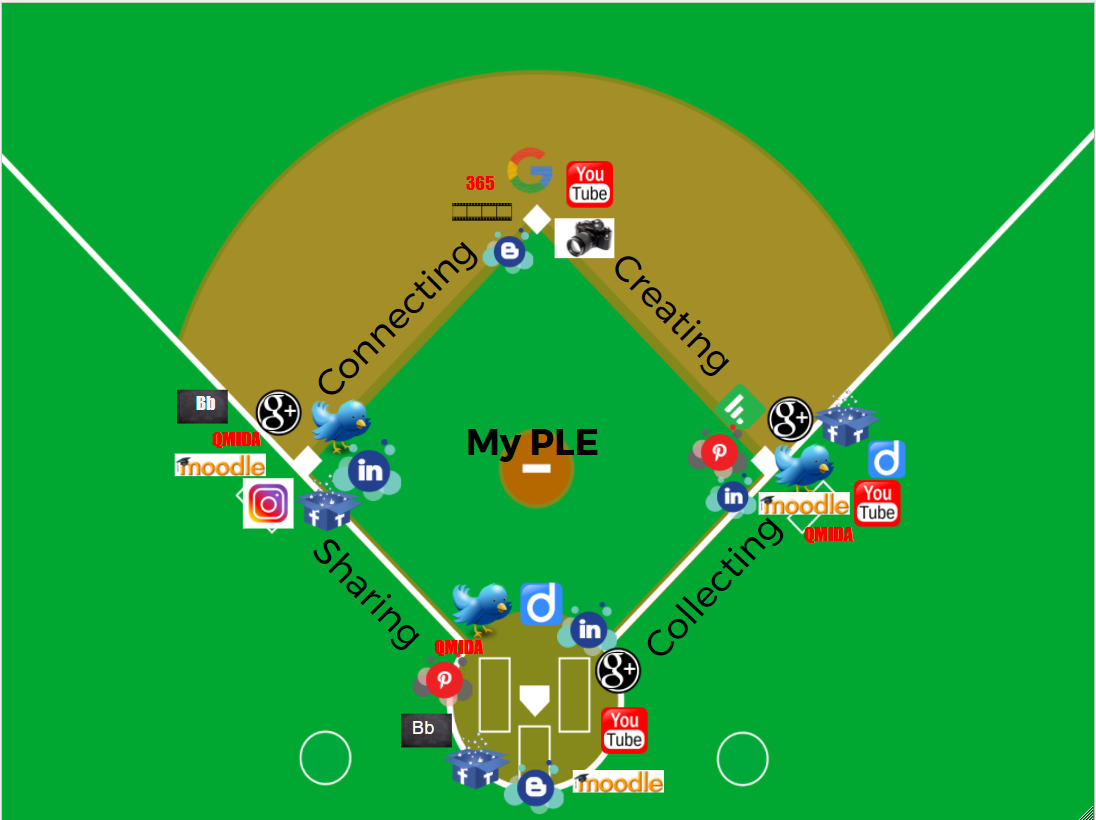
After logging in to some new online communities (two from Google +, one from Linked In, and one from Quality Matters) to my Personal Learning Environment (PLE), I created this diagram using Google Drawings. This was my first time using Google Drawings. It was very simple to use, and it was very easy to find and insert public domain images using this tool. I will be back for more!
After reading about the different models, I was torn between the 4 C’s model and the model with gathering, processing, and acting on learning. Really, they are very similar. I decided to use the four C’s, but I changed the wording a bit and went with the categories of collecting, creating, connecting, and sharing, and then I finally decided on a baseball theme as a metaphor for learning is fun, The design shows connections between the communities at the bases, as well as, along the base paths, and it illustrates the cyclical process of learning as you round the bases.
In looking at my PLE, the areas are pretty balanced and a number of the communities are used in multiple ways which is why it’s a little crowded around those bases. The creating section is more tools for creating things for myself and to share. What I learned in looking at the PLE is that I have a large learning environment. That makes sense since learner is my top strength according to the StrengthsQuest assessment that I’ve taken in the past. When I think about it, it seems as if I spend a little more time collecting than I do creating, connecting, and sharing. However, in my work as an instructional designer, I do more one on one connecting, creating items for courses, and sharing through the courses I’ve worked on and with instructors in the process of developing a course. In my time outside of work, I definitely do more collecting than the other areas, but it’s my goal to change that and bring more balance to my playing field.
Comparisons
In looking at each PLE diagram listed below, at first I was surprised how similar they are. After thinking about it more though, this is how we teach. Each of us chose basically the same categories, however there were some slight twists in wording. We had most communities in common and then a few outlying ones. Even when we had communities in common, they were categorized a bit differently in some cases which could be partly due to using them in different ways. It appears that I have a hard time making decisions – since many of communities are in multiple categories.

 Catalyst